The future of Ukrainian refugees in the Netherlands
Since the grand-scale invasion of Ukraine, the Netherlands has received more than 130.000 of Ukrainian refugees. Their legal status allows them to work and go to school, but the majority lives in crisis shelter. But with this temporary status changing in 2027, housing under stress and an uncertain outcome of the war, it is increasingly difficult to make plans for the future. On the eve of the 4th anniversary of Russia’s full scale invasion, we discuss the Ukrainian experience in the Netherlands. How do you balance the hope for a future in Ukraine with the realities of building a life in the Netherlands? How do you take charge of your life when you are dependent on the policies of the Dutch government, and the proposed long term policies of the Dutch government are far from clear? A discussion on the needs of Ukrainians, the capacities of Dutch municipalities and long term thinking in an uncertain world.Programme editor: Veronica BaasModerator: Lennart Booij
Laatst uitgezonden
zaterdag 2 mei 2026
op SALTO2
Meer van De Balie TV
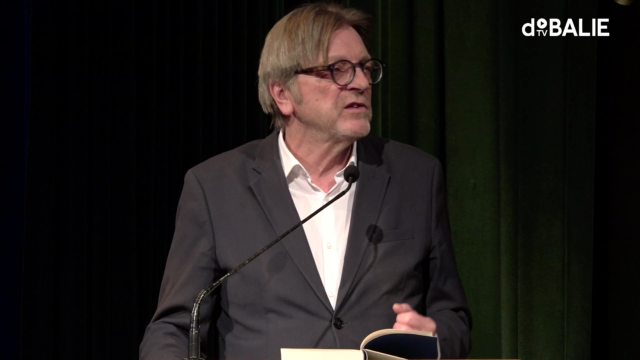
Guy Verhofstadt: een nieuwe liberale democratie
De democratie in het Westen wordt van binnenuit en van buitenaf onder druk gezet. In De burger in opstand schetst Guy Verhofstadt, voormalig minister-president van België, een blauwdruk voor een nieuwe liberale democratie.‘Democratieën verworden tot oligarchieën, waarin populistische leiders met steun van een rijke elite over massa’s regeren, en via de media die ze bezitten een vertekend beeld geven van de werkelijkheid en van hun intenties om problemen op te lossen’, aldus Guy Verhofstadt in De burger in opstand. Verhofstadt stelt in zijn boek radicale hervormingen voor, van een nieuw kiessysteem tot een andere verhouding tussen arbeid en kapitaal. Wat is er nodig om de liberale democratie te hervormen en te behouden? Guy Verhofstadt (1953) was bijna tien jaar lang minister-president van België. Daarna was hij lange tijd leider van de liberalen in het Europees Parlement. Van 2016 tot 2020 was hij Brexit Coördinator voor het Europees Parlement en voorzitter van de Brexit Steering Group. Verhofstadt publiceerde verschillende boeken over politiek en Europa.Stefan de Vries is journalist en spreker, gespecialiseerd in Europese politiek en ontwikkelingen. Hij is Europaverslaggever voor BNR en een veelgevraagd duider in Nederlandse en internationale media, met eerdere ervaring als correspondent in Parijs. Zijn analyses verbinden actuele politiek met geschiedenis, cultuur en persoonlijke observatie.Programmamakers: Ianthe Mosselman en Dirk StruikModerator: Liesbeth Staats
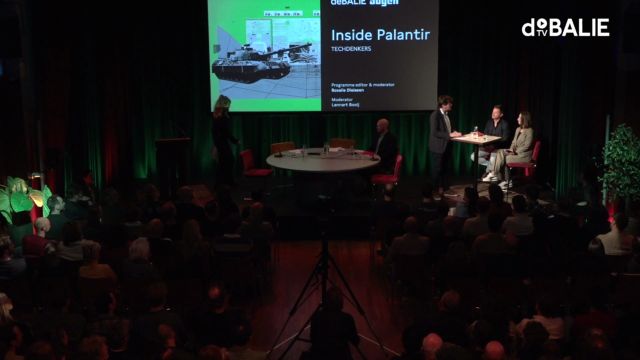
Inside Palantir: Techdenkers with Richard Evans (Palantir Technologies)
Palantir is one of the most powerful and most mysterious companies in the world. The American tech giant, co-founded by MAGA supporter Peter Thiel, provides essential and controversial technology to (Western) militaries and police forces. The Dutch government is also a client. How desirable is that?Palantir, named after the magical seeing stones from Lord of the Rings, develops software that can link, analyze, and visualize enormous amounts of data. The company supplies armies, intelligence agencies, and police services: from the Ukrainian military to help hold back the Russians to the U.S. immigration enforcement agency ICE to track down migrants.The Netherlands has also been using Palantir technology for years, largely outside public view, according to research by Follow the Money. The Dutch military has worked with it since 2010; the National Police uses the software as the core of its data platform for combating serious crime. Large volumes of police data – from incident reports to telecom and location data – are made searchable and analyzable through a single system. Palantir itself states that it only provides a platform and does not process the data.This use raises fundamental questions. How transparent are these systems? Who oversees the algorithms? What safeguards exist against errors, bias, or wrongful suspicion? And what does it mean for our digital sovereignty?About the speakers:Richard Evans is a member of Palantir’s Privacy & Civil Liberties Engineering Team (PCL), working at the intersection of policy, ethics, law and software engineering, and helping to ensure that Palantir’s platforms are built and deployed in ways that uphold rights to privacy and other civil liberties. Based in London, Richard has worked across Palantir’s UK defence, UK healthcare, and international public sector businesses since joining the company in 2017. Richard was previously lawyer in the New Zealand Government, focused on public and constitutional law.Ellen Mok is the founder of Digitale Doetank, a mission-driven advisory firm focused on digital sovereignty and the strategic use of (emerging) technologies. With a background in cyber strategy and national security, she previously worked at KPMG as Manager Cyber Strategy & Risk, where she helped establish the nation-state threats team, and at the Dutch General Intelligence and Security Service (AIVD) as a Cyber Security Advisor and Researcher. Ellen holds two MSc degrees: one in Engineering & Policy Analysis (TU Delft) and another in Crisis & Security Management (Leiden University). She combines technical knowledge with political experience, being a candidate for the European Parliament with D66. Her focus areas include digital sovereignty, tech policy, and national security.Jochem de Groot is director of policy at NLdigital, the trade association of the Dutch digital sector. He wrote the book “Kolonisten van de Cloud” (Colonists of the Cloud), about the geopolitical role of tech companies. He is connected to the Advisory Council of International Affairs and the Netherlands Atlantic Association. Furthermore, he has worked at Microsoft, Philips and the Ministry of Foreign Affairs.Programme editor: Rosalie DielesenSupported by: Adyen
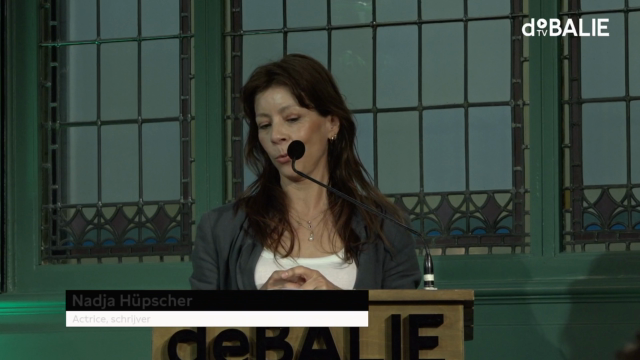
Jongens toch: tussen opvoeding en algoritme
Manosfeer. Giftige mannelijkheid. Crypto-influencers. Het gesprek over jongens gaat dikwijls over wat er gebeurt als de verkeerde afslag al genomen is. Maar hoe voorkom je dat het zo ver komt?Mannelijkheid roept meer vragen op dan ooit en maakt jongens vatbaar voor stemmen die simpele antwoorden bieden. Waarom raken sommige jongens verstrikt in het net van verkeerde rolmodellen en anderen niet? Welke rol spelen opvoeding, school en de sociale omgeving en hoe weet je of je zoon, leerling of vriend ergens tussen de onzichtbare algoritmes, groepschats en online communities aan het afglijden is?Dirk Schrijver, Jens van Tricht, Lauk Woltring en Nadja Hüpscher gaan in gesprek over wat we kunnen doen om te voorkomen dat die jongens de verkeerde afslag nemen.Tijdens het programma vormen vier jonge mannen uit de Jongerenadviesraad Amsterdam (JARA) – Ahmed Ringim Mohammed, Amjad Almatni, Giovanni van Bossé en Rafaël Nooij – een live klankbord in de zaal. Zij reageren tussendoor op het gesprek, stellen vragen aan de sprekers en brengen het perspectief van jonge Amsterdammers het podium op.Programmamaker: Dirk StruikModerator: Liesbeth StaatsIn samenwerking met: JARA
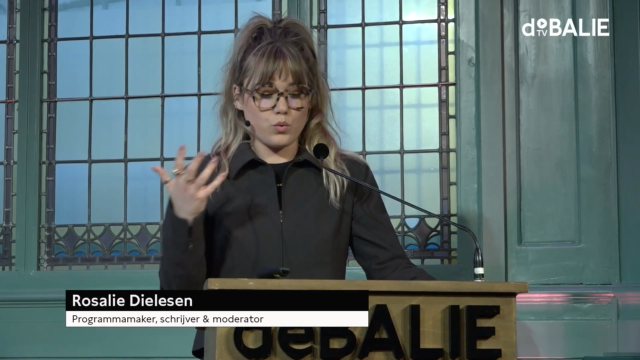
Nederland, gidsland? – over queer emancipatie en politiek
Ooit stond Nederland bekend als gidsland, maar op het gebied van lhbtiq+-beleid is er de afgelopen jaren weinig wetgeving door de Tweede Kamer aangenomen. Ondertussen stagneert de acceptatie van lhbtiq+’ers. Welke invloed heeft de politiek op het dagelijks leven van queer mensen in Nederland?Van de allereerste Nederlandse homodemonstratie in 1971, de pragmatische aanpak van de aidscrisis in de jaren 80 tot het openstellen van het huwelijk voor gelijke geslachten: de queer emancipatiegeschiedenis wordt graag voorgesteld als een van gestage vooruitgang – en uiteindelijk: voltooiing. Maar hoe eenduidig is dat verhaal? Tijdens dit programma nemen we het idee van Nederland als gidsland onder de loep. Hoe hebben lhbtiq+’ers de afgelopen decennia hun plek in de samenleving opgeëist? Welke rol heeft de politiek daarin gespeeld? En waar staan we nu? De emancipatiegeschiedenis is geen voltooid verleden tijd. Nederland daalt al jaren op ranglijsten wat betreft de rechten van lhbtiq+’ers (op de toonaangevende Europese Rainbow Ranking neemt Nederland plek 13 in). Wat betreft wetgeving is er vooral sprake van stilstand, zo illustreerde de vorig jaar afgeschoten en veelbesproken Transgenderwet nog maar eens. Welke invloed heeft dat op het dagelijks leven van queer mensen?Programmamaker: Rosalie Dielesen
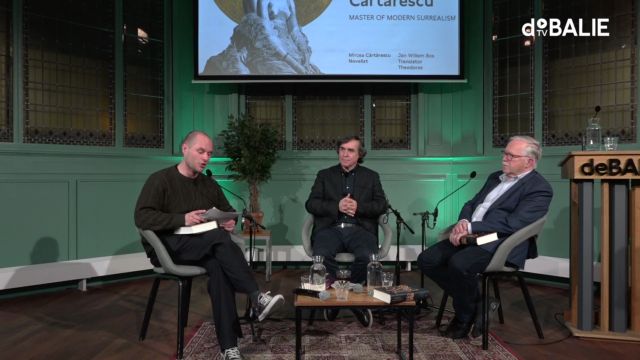
Mircea Cărtărescu: Master of Modern Surrealism
Can obsession turn an impossible dream into reality? In conversation with the master of modern surrealism Mircea Cărtărescu about Theodoros, a novel about the rise of an unlikely emperor.Theodoros is set in the nineteenth century and follows the extraordinary life of the otherwise ordinary Teodor, the son of two servants of a Romanian aristocrat. Raised on stories of Alexander the Great told by his Greek mother, he becomes obsessed with the idea that he too is destined for greatness — and everything else must give way to it. His improbable life path eventually leads him to Ethiopia, where he ascends the throne as Emperor Tewodros II. Theodoros is a surreal epic, written in rich, distinctive prose.About the speakersMircea Cărtărescu (Bucharest, 1956) is considered one of the most important voices in contemporary European literature. His novels and poetry have been widely translated and awarded, and his acclaimed novel Solenoid was hailed by the European press as a masterpiece.Jan Willem Bos (1954) translated more than twenty-five novels, short-story collections, and poetry collections from Romanian. He has also published numerous articles and written several nonfiction books about Romania.Remo Verdickt (1992) is a literary scholar and specialised in Mircea Cărtărescu’s work. He wrote several articles about him, including in De Standaard and Los Angeles Review of Books. He is currently a postdoctoral researcher in literature at KU Leuven. Programme editor: Ianthe MosselmanIn cooperation with: Roemeens Cultureel Instituut Brussel
